From OP_RETURN to Lightning: My Journey Down the Bitcoin Rabbit Hole

Explore my tools: agents-skills-plugins
The OP_RETURN Temptation
When Bitcoin Core v30 dropped with expanded OP_RETURN limits, I got excited. Really excited. The idea of putting arbitrary data on-chain - permanent, censorship-resistant, immutable - has always been appealing. Now we could store more than the old 80-byte limit.
I immediately started experimenting.
The Testnet Dream
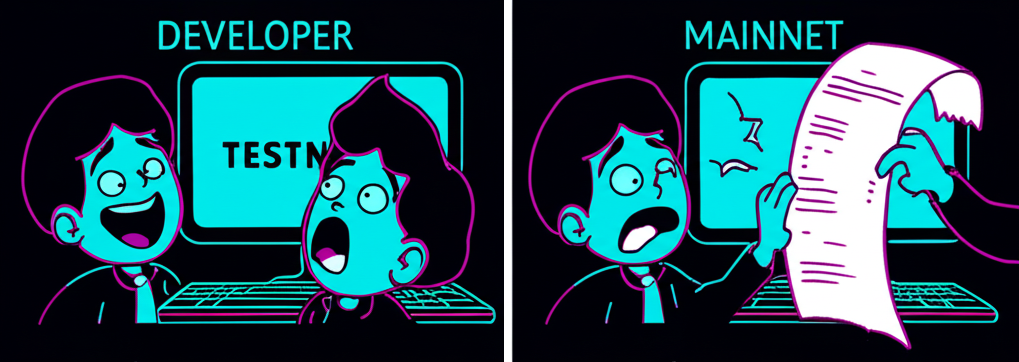
On testnet, everything worked beautifully. I was embedding messages, hashes, small data payloads. The transactions confirmed. The data was there. Permanent. On the Bitcoin blockchain.
// The dream: arbitrary data on the most secure ledger in existence
const opReturnOutput = {
  script: bitcoin.script.compile([
    bitcoin.opcodes.OP_RETURN,
    Buffer.from('Hello from the blockchain', 'utf8')
  ]),
  value: 0
};
I built a simple message system. Sender embeds encrypted message in OP_RETURN. Recipient watches the chain. Messages are permanent, uncensorable, and tied to the most secure network on the planet.
Then I switched to mainnet.
The Fee Wall
Reality hit fast. Mainnet fees are not testnet fees.
A simple OP_RETURN transaction with a modest payload? 10,000+ sats during busy periods. For a message. That I could send for free on Signal.
I ran the numbers:
- Average message: ~200 bytes
- Transaction overhead: ~150 bytes
- At 50 sat/vbyte: ~17,500 sats per message
- At current prices: roughly $15 per message
That's not a messaging system. That's a luxury good.

I tried optimizing. Batching messages. Compressing payloads. Using shorter encodings. None of it made economic sense for anything resembling regular communication.
// The reality check
const feeRate = await getFeeEstimate(); // 50 sat/vbyte
const txSize = 250; // bytes, optimistic
const feeSats = feeRate * txSize; // 12,500 sats minimum

// Is this message worth $10+?
// For most use cases: no.
The Sidechain Detour
Okay, I thought. What about sidechains? Lower fees, still Bitcoin-adjacent, maybe I can get the permanence without the cost.
I explored a few options:
- Liquid: Better fees, but still not cheap for high-volume messaging
- RSK: Interesting, but added complexity
- Stacks: Different trade-offs entirely
Each had merits. Each had drawbacks. None felt right for what I was trying to build.
The problem wasn't the technology. The problem was me trying to force a use case onto the wrong layer.
The Lightning Realization
Every path I explored kept pointing back to Lightning.
Not as a compromise. As the right answer.
Think about it:
- Sub-satoshi fees
- Near-instant settlement
- Payment channels can carry data (keysend, custom records)
- Onion routing for privacy
- No permanent blockchain bloat
The predecessors to Lightning - payment channels, the original Lightning paper, early implementations - they solved this problem years ago. I was just too fixated on "data on L1" to see it.
// Lightning: the answer that was there all along
const keysendPayment = {
  dest: recipientPubKey,
  amt: 1, // 1 sat, the minimum
  customRecords: {
    // TLV type for custom data
    34349334: Buffer.from(encryptedMessage)
  }
};

// Cost: ~1 sat + routing fees (usually <10 sats)
// Speed: seconds
// Privacy: onion routed
What OP_RETURN Is Actually Good For
This isn't me saying OP_RETURN is useless. It's not. It has legitimate use cases:
- Timestamping - Proving a document existed at a certain time. One transaction, permanent proof.
- Anchoring - Committing to off-chain data. A hash on L1, full data elsewhere.
- Protocol markers - Identifying transactions as part of a specific protocol.
- Rare, high-value data - When permanence is worth the cost.
But for my use case - a messaging system, frequent transactions, real-time communication - OP_RETURN doesn't make sense. The economics don't work. The latency doesn't work. The scalability doesn't work.
The Rabbit Hole Was Worth It
Here's the thing: I don't regret the detour.
Going deep on OP_RETURN taught me exactly why Lightning exists. Reading the original payment channel proposals, understanding the evolution from simple 2-of-2 multisig to HTLCs to the modern Lightning Network - it all clicked in a way it wouldn't have if I'd just started with Lightning.
Sometimes you need to hit the wall to appreciate the door.

What's Next
I'm building on Lightning now. The encrypted message queue I wrote about uses Lightning as the transport layer. It works. It's cheap. It's fast.
But I haven't abandoned OP_RETURN entirely. For the right use case - timestamping, anchoring, one-time proofs - I'll be back. The expanded limits in Core v30 do open up possibilities.
Just not for messaging. Not for anything high-frequency. Not for anything where "a few dollars per transaction" breaks the model.
The Bitcoin ecosystem has layers for a reason. L1 for security and settlement. L2 for speed and scale. Trying to do everything on L1 is like trying to store your grocery list in a bank vault. You can. But why would you?
The Lesson
Every technology has its layer. OP_RETURN is for permanence. Lightning is for speed. Sidechains are for experimentation. L1 is for settlement.
I spent weeks learning this the hard way. Hopefully this saves you the trip.
Build where it makes sense. Not where it seems cool.
Working on Bitcoin infrastructure? I'm always exploring at Chainbytes. And if you're building with Claude Code, check out my agents-skills-plugins for blockchain development skills.
One reaction per emoji per post.
// newsletter
Get dispatches from the edge
Field notes on AI systems, autonomous tooling, and what breaks when it all gets real.
You will be redirected to Substack to confirm your subscription.